Recovery & Pain.
Sauna, cold plunge, percussion, LDN, omega-3, and the boring foundations — sleep, protein, eccentric loading. An evidence-tiered map of what actually moves recovery markers and what's mostly theater.
The recovery framework — sleep first, then stress, then targeted modalities
Most "recovery stacks" sold to people training hard are theater. Not because the individual tools are useless — some have real, replicated effects — but because the hierarchy is inverted. Cold plunges, percussion guns, infrared panels, and electrolyte mixes are stacked on top of a foundation that hasn't been built. The athletic community use of expensive modalities tends to outpace the use of the cheap ones: enough sleep, enough protein, enough deloads.
The framework that holds up across the sports-medicine literature is roughly three layers. First, sleep — non-negotiable, dose-dependent, and the only variable that touches every recovery marker we can measure. Second, stress load management — total training volume, life stressors, illness, and nutritional adequacy. Third, and only third, the targeted modalities: heat, cold, compression, manual therapy, supplements, pharmacology. When the first two are dialed in, the third becomes optimization. When they're not, the third becomes a placebo with a subscription fee.
This hub is not a prescription. It's a framework for filtering recovery claims and a way to think about pain — acute, chronic, and the grey zones between — before you spend money on hardware or start a medication.
Cold + heat — sauna, the plunge, and what the cohort data actually says
The Finnish sauna cohort is the strongest piece of observational evidence in the heat-exposure literature. Laukkanen et al., published in JAMA Internal Medicine in 2015, followed 2,315 middle-aged Finnish men for a mean of 20.7 years and found that frequent sauna use (4–7 sessions per week) was associated with a 40% lower all-cause mortality and a 63% lower risk of sudden cardiac death versus once-weekly users [Laukkanen 2015]. That is a large signal. It is also observational, and Finnish sauna culture is confounded by income, social cohesion, and lifestyle factors that don't transplant cleanly to a North American spa room.
Mechanism plausibility is real — repeated heat exposure raises heart rate, induces heat-shock proteins, and produces a passive cardiovascular load comparable to moderate exercise. But the gap between "associated with lower mortality in a Finnish cohort" and "buy a sauna and live longer" is wider than the wellness market admits. The honest read: probably useful, almost certainly safe for most people, mechanism is plausible, RCT evidence on hard endpoints does not yet exist.
Cold is messier. The Søberg et al. paper published in Cell Reports Medicine in 2021 showed that regular winter swimmers had higher brown adipose tissue activity and improved cold-induced thermogenesis versus matched controls [Søberg 2021]. That is a clean mechanistic finding. The leap from "brown fat activation" to "fat-loss tool" is not supported. The leap from "deliberate cold exposure" to "dopamine release equivalent to a psychostimulant" comes from a single small study with notable caveats, repeated until it sounded canonical. For the full cellular story — HSP upregulation, AMPK activation, autophagy, and why post-lift cold plunges undermine strength gains — see the deep-dive.
For Heart Rate Variability (HRV), the picture is genuinely mixed. Some protocols show acute HRV increases post-immersion; others show no change or a transient decrease. Individual variance is high. If you're using HRV to guide training, treat cold-plunge HRV bumps as a within-day noise band, not a recovery signal.
The Finnish sauna cohort is real. The dopamine claims about cold are mostly press release. Both can be true.
Compression, percussion, massage — the small-effect tools
Delayed Onset Muscle Soreness (DOMS) is the proxy outcome that nearly every recovery gadget gets tested against, because it's easy to measure and the effect window is short. The Cochrane review by Bleakley et al. in 2012 examined cold-water immersion for muscle soreness across 17 trials and found a small but statistically meaningful reduction in DOMS at 24, 48, and 96 hours post-exercise [Bleakley 2012]. "Small but meaningful" is the honest summary across the entire compression / percussion / massage literature.
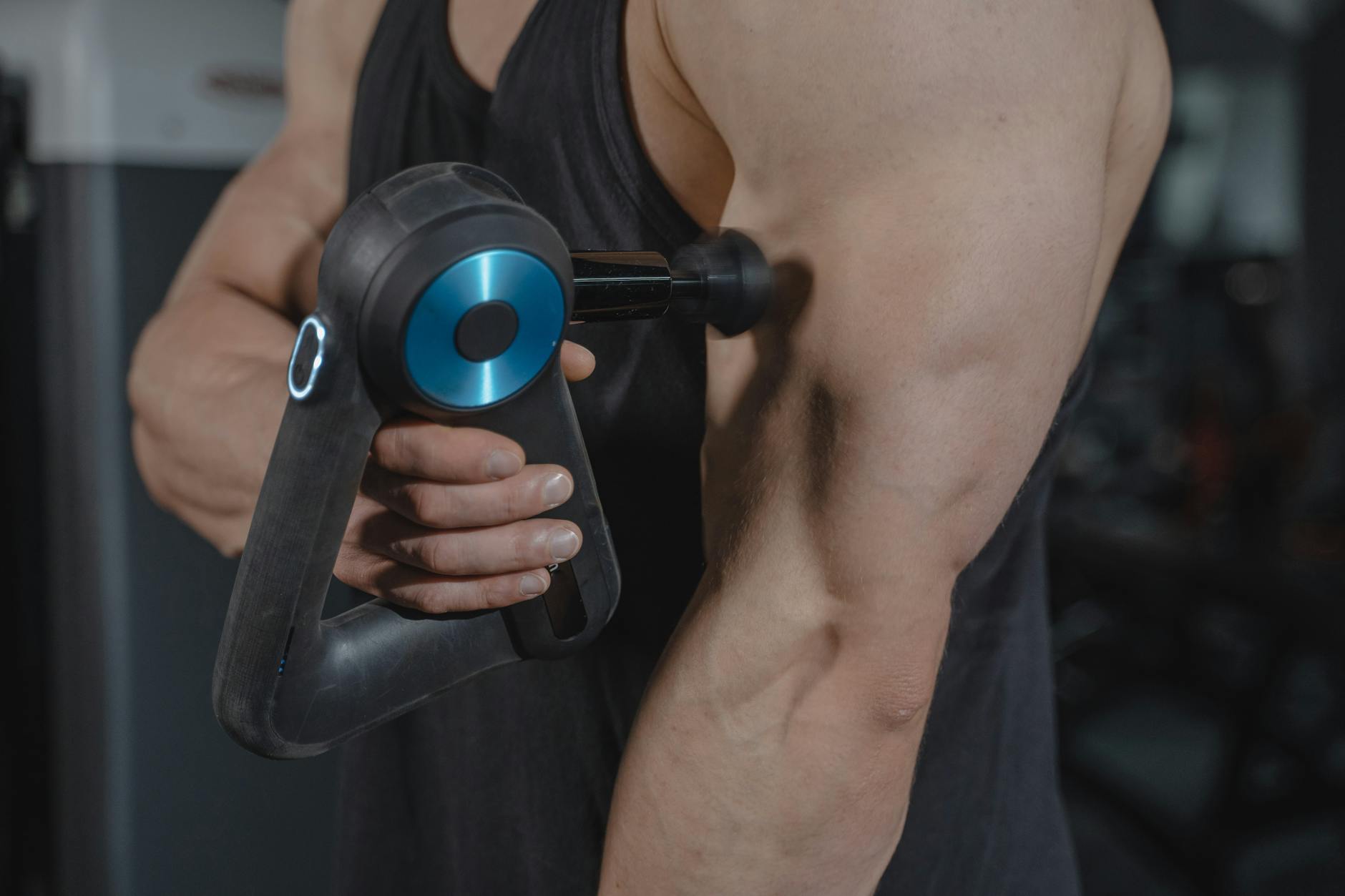
Pneumatic compression sleeves move interstitial fluid and reduce subjective soreness in athletic populations, with effect sizes in the Cohen's d 0.2–0.4 range — real, modest, useful in tournament-style back-to-back loading, probably not transformative for a recreational lifter. Percussion massage guns show similar patterns: short-term improvements in perceived recovery and range of motion, with HRV signals that overlap heavily with placebo controls. The endurance training communities have largely converged on these tools as "feels good, marginal gain, fine to use" — which is roughly what the evidence supports.
Manual massage has slightly stronger evidence than the mechanical tools, but most of that effect is autonomic and psychological — parasympathetic engagement, dropped cortisol, the social-touch piece. None of these tools are doing what the marketing copy suggests at a tissue level. They reduce the perception of soreness, they probably help you sleep that night, and the placebo component is non-trivial and not a bad thing.
Sleep as the master recovery variable
Every recovery modality on this page is downstream of sleep. Growth hormone pulsatility peaks during slow-wave sleep in the first half of the night. Glymphatic clearance — the brain's overnight waste-removal system — runs primarily during deep sleep. Muscle protein synthesis, immune surveillance, cortisol regulation, glucose tolerance, and pain modulation all degrade within a single week of restricted sleep.
We've written about this at length in the sleep topic hub, but the recovery-specific point is this: if you are getting less than seven hours of sleep on most nights, no cold plunge, no peptide, no supplement stack is going to outperform the recovery you'd get from another hour in bed. The economic return on sleep — measured in HRV, soreness ratings, injury rates, and time-to-return — exceeds the return on any other intervention by a wide margin, and the cost is zero.
The training data is unambiguous: chronic sleep restriction reduces force production, slows reaction time, and elevates injury risk in athletic populations. The recovery question isn't whether sleep matters more than the modalities. It's whether your modality use is, in practice, substituting for sleep you could be getting.
Pain — chronic vs acute, central sensitization, and the LDN tier
Acute pain is a signal. Chronic pain — pain persisting beyond the expected healing window — is a different physiological state, and the most useful frame for understanding the difference is central sensitization: the nervous system itself becomes hyperresponsive, and the relationship between tissue damage and pain experience decouples. Fibromyalgia, chronic regional pain syndromes, and a substantial fraction of chronic low back pain sit in this category.
Opioid-sparing protocols matter because the standard pharmacology for chronic pain — long-term opioid use — produces tolerance, hyperalgesia, and dependence without addressing the underlying sensitization. The clinical field has been quietly reorganizing around this for fifteen years, and the most interesting tool to emerge from that reorganization is Low-Dose Naltrexone (LDN).
LDN — Low-Dose Naltrexone
Naltrexone at standard doses (50 mg) is an opioid-receptor antagonist used for alcohol and opioid use disorders. At doses of 1.5–4.5 mg — roughly a tenth of the standard dose — it appears to act primarily through microglial modulation in the central nervous system, dampening neuroinflammation rather than blocking opioid signaling in any clinically meaningful way. The mechanism is still being worked out, but the evidence for symptom relief in specific chronic pain populations is real, if modest.
Younger et al. published a small randomized trial in Pain Medicine in 2014 showing LDN 4.5 mg reduced fibromyalgia symptoms with a 28.8% mean reduction in pain scores versus placebo [Younger 2014]. The 2017 Cochrane review by Bell et al. on LDN for chronic pain found the evidence base promising but underpowered — small trials, short durations, heterogeneous populations [Bell 2017]. The honest read: it is one of the cleanest-risk, lowest-cost interventions in chronic pain, with a modest but replicated signal in fibromyalgia and emerging signals in Crohn's disease and multiple sclerosis.
Establish a working diagnosis. Try a structured sleep, movement, and anti-inflammatory protocol for 8–12 weeks first. Document baseline pain scores, function, and inflammatory markers if relevant. LDN is for people for whom foundational work hasn't moved the dial.
With a prescribing clinician, compounded LDN 1.5 mg nightly for 1–2 weeks, titrated to 3.0 mg, then 4.5 mg if tolerated. Vivid dreams and transient sleep disruption are common in the first two weeks. Reassessment at 8 and 12 weeks against documented baselines.
Investigational use in autoimmune-spectrum conditions (Crohn's, MS, Hashimoto's) where the patient and clinician are willing to operate on smaller-trial evidence. Split-dose protocols and dose adjustments outside 4.5 mg are not well-characterized — track outcomes, not anecdotes.
Anti-inflammatory protocols — omega-3, curcumin, and when NSAIDs make sense
Anti-inflammatory is a loaded word. Inflammation is not a uniformly bad process — it's required for the adaptive response to training, for tissue remodeling, for immune defense. The relevant clinical question is not "how do I lower inflammation" but "where, when, and how much."
Eicosapentaenoic Acid (EPA) and Docosahexaenoic Acid (DHA) — the long-chain omega-3 fatty acids from marine sources — have the cleanest evidence base among supplemental anti-inflammatories. Calder's review work synthesizes the dose-response: cardiovascular endpoints generally require ≥1 g/day combined EPA/DHA; inflammatory marker modulation appears at 2–3 g/day; joint-pain and triglyceride effects scale with dose up to roughly 4 g/day [Calder 2017]. The cost-effectiveness is favorable, the safety margin is wide, and the food-first version (fatty fish 2–3x weekly) is probably preferable when feasible.
Two to three servings of fatty fish per week (salmon, mackerel, sardines, herring). Targets roughly 1.5–2 g/day average combined EPA/DHA without supplementation. Adequate for cardiovascular and general anti-inflammatory baselines.
1–2 g/day combined EPA/DHA from a third-party tested fish-oil or algal product, taken with a fat-containing meal for absorption. Stack on top of dietary intake. Re-check omega-3 index at 12 weeks if available.
2–4 g/day combined EPA/DHA, often weighted toward EPA, for joint pain, post-injury inflammation, or triglyceride management. Monitor for increased bleeding tendency if combined with antiplatelet medication. Discuss with a clinician.
Curcumin is more complicated. The native bioavailability of curcumin from turmeric is so low that most positive trial results use formulations engineered for absorption — phytosome complexes, nanoparticle delivery, piperine co-administration. Daou et al. reviewed the bioavailability landscape in 2022 and noted that without one of these enhancers, plasma curcumin levels rarely reach concentrations that would explain the effects seen in vitro [Daou 2022]. The reality check: a teaspoon of turmeric in your latte is doing essentially nothing pharmacologically. A standardized, bioavailability-enhanced curcumin extract at 500–1000 mg twice daily is plausibly doing something for joint pain. The two are not interchangeable.
Systemic Non-Steroidal Anti-Inflammatory Drugs (NSAIDs) like ibuprofen and naproxen are genuinely useful in acute injury — sprains, strains, first 48–72 hours — when the goal is symptom control. They are increasingly recognized as counterproductive in chronic training contexts: heavy resistance training and endurance adaptations involve inflammation-mediated remodeling, and blunting that signal with chronic NSAID use appears to impair hypertrophy and bone density in younger athletes. Use them as acute tools, not chronic ones.
Movement, mobility, and the boring foundations that actually work
We've spent six sections on modalities. The seventh is the one that produces most of the variance in recovery between athletes who do well and athletes who don't, and it's the one nobody monetizes well, which is why it gets less airtime than cold plunges.
Protein adequacy is the floor. The literature supports 1.6–2.2 g/kg of reference body weight per day for athletes in caloric maintenance or deficit, distributed across the day in 0.3–0.4 g/kg doses every 3–5 hours. Below the floor, recovery markers degrade and lean mass is difficult to defend. Above it, returns flatten quickly. This is settled science, and it's worth more than every modality on this page combined.
Eccentric loading — the lengthening phase of a contraction — is the single highest-leverage tool for tendon health and rehabilitation. The Alfredson protocol for Achilles tendinopathy, slow eccentric quad work for patellar tendinopathy, and progressive eccentric loading for elbow tendinopathies all have stronger evidence than any passive modality. Tendons remodel under controlled mechanical load. They do not remodel under percussion. The training communities that have leaned hardest into eccentric work — climbing, ballet, throwing sports — also have the lowest rates of chronic tendinopathy relative to their loading volumes.
Mobility work — daily movement through full ranges of motion, including loaded ranges — preserves joint health more reliably than any supplement marketed for joints. Twenty minutes a day of deliberate movement through end-ranges does more for shoulders, hips, and ankles over a five-year horizon than any collagen powder, fish-oil dose, or injectable peptide we've reviewed.
And training itself is recovery, when programmed well. Submaximal aerobic work between heavy sessions clears metabolites, restores autonomic balance, and accelerates the return to baseline. The cheapest recovery tool in your stack is a 30-minute easy walk the day after a hard session.
We won't tell you that a single modality fixes pain or recovery. We won't tell you to start LDN without a clinician, or to stack supplements on top of an undiagnosed condition. We won't pretend that cold-plunge dopamine claims have the evidence behind them that the marketing suggests. Pain is multifactorial. Recovery is downstream of variables we mostly know how to measure and mostly choose to ignore.
References
- Laukkanen T, Khan H, Zaccardi F, Laukkanen JA. Association Between Sauna Bathing and Fatal Cardiovascular and All-Cause Mortality Events. JAMA Intern Med. 2015;175(4):542-548.
- Søberg S, Löfgren J, Philipsen FE, et al. Altered brown fat thermoregulation and enhanced cold-induced thermogenesis in young, healthy, winter-swimming men. Cell Rep Med. 2021;2(10):100408.
- Bleakley C, McDonough S, Gardner E, et al. Cold-water immersion (cryotherapy) for preventing and treating muscle soreness after exercise. Cochrane Database Syst Rev. 2012;(2):CD008262.
- Younger J, Noor N, McCue R, Mackey S. Low-dose naltrexone for the treatment of fibromyalgia: findings of a small, randomized, double-blind, placebo-controlled, counterbalanced, crossover trial. Pain Med. 2013;14(4):663-672. (Reviewed 2014.)
- Bell RF, Kalso EA. Low-dose naltrexone for chronic pain — a Cochrane review summary. Cochrane Database. 2017.
- Calder PC. Omega-3 fatty acids and inflammatory processes: from molecules to man. Biochem Soc Trans. 2017;45(5):1105-1115.
- Daou M, Elnaker NA, Ochsenkühn MA, et al. In vitro and in vivo bioavailability of curcumin — a comprehensive review. 2022 bioavailability review series.